24Jan 2014

Attractive Michigan Girl of the Week
online pharmacy purchase amaryl no prescription with best prices today in the USA

If you have any other pictures of girls wearing Michigan gear, drop me an e-mail. Go Blue!

If you have any other pictures of girls wearing Michigan gear, drop me an e-mail. Go Blue!
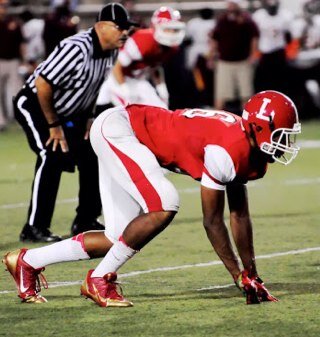 |
| Orange (CA) Lutheran defensive end Keisean Lucier-South |
Name: Keisean Lucier-South
Height: 6’6″
Weight: 218 lbs.
High school: Orange (CA) Lutheran
Position: Defensive end
Class: 2015
Notes: Holds offers from Arizona, Arizona State, Boise State, California, Colorado, Miami, Michigan, Notre Dame, Oregon, Oregon State, TCU, Tennessee, Texas, UCLA, USC, Vanderbilt, and Washington . . . Claims a 4.7 forty time . . . Had 10 sacks as a junior in 2013 . . . ESPN 4-star, 82 grade, #9 DE, #65 overall . . . Rivals 4-star, #7 WDE, #80 overall . . . Scout 5-star, #2 DE . . . 247 Sports 4-star, 96 grade, #6 WDE, #57 overall
Strengths: Long-armed with good frame to add weight . . . Quick first step that gets offensive tackles to open up sooner than they like . . . Comes around corner with inside shoulder dipped . . . Plays with good knee bend . . . Spikes inside well due to leverage . . . Good change of direction . . . Lowers hips at point of contact, allowing him to stay with shorter players . . . Uses hands and long arms well to disengage from blockers and wrap up ball carriers . . . Very good speed . . . Takes proper angles and does not often need to readjust pursuit
Weaknesses: Needs to add weight and get stronger . . . Overpowers some high school linemen due to quickness and ability to play low, but needs to play more violently to beat players at next level . . . Does not display a variety of pass rush moves
Projection: Weakside end. The key for Lucier-South will be whether he maintains his athleticism while he adds weight, because he’s very thin now. If he can maintain his speed and change of direction, he should be able to remain at weakside end and give offensive tackles fits with his length and quickness. If that speed starts to dwindle once he adds another 40-50 lbs. of muscle, then he may need to move to strongside end. He plays with enough leverage to take on tight ends and tackles on the strong side, so that wouldn’t spell disaster for him. Perhaps the most encouraging thing is his pursuit angles, which combine with his understanding of leverage to suggest that he comprehends the game on a higher level than “see ball, get ball.” Also, Maxpreps named his school’s league (the Trinity League) as the #2 most difficult conference in the nation, so he’s having success against quality competition. That league includes St. John Bosco (Josh Rosen, Jaleel Wadood, Damien Mama) and Mater Dei (Matt Barkley, Matt Leinart, Max Wittek), among others.
Reminds me of: Taco Charlton. Michigan hasn’t successfully recruited many guys like Lucier-South in recent years, so while I think Lucier-South is more refined as a player than Charlton was, they are comparable when it comes to size and natural athleticism.
Likelihood of committing to Michigan:
Lucier-South has been pining for a Michigan offer for a long time and called Michigan his “dream school.” Still, he lives on the west coast and is being pursued by the likes of Notre Dame, Texas, and USC, so there’s no shortage of suitors to try to convince him otherwise. No other strong leaders appear to have emerged, so I think Michigan has as good of a shot as anyone.
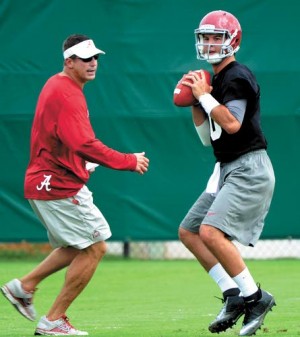 |
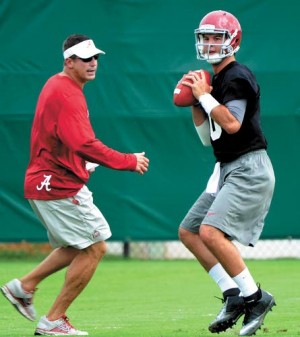
| Doug Nussmer works with A.J. McCarron at Alabama |
Hello,
Thank you for the great content on your site. I was thinking recently about position coaches, especially with the happenings at Michigan regarding our new OC/QB coach and speculation about the OL coach and how long Fred Jackson may stay on.There’s always a grass is greener attitude among fanbases, and Michigan is no exception. Your honesty is probably the least susceptible to this way of thinking, which is refreshing. In this regard, I was thinking it might be a good piece for your blog to discuss the relative importance of each position coach. For instance, on average which is better to have for developing players–a good RB coach or a good OL coach? Is the RB position naturally more about athleticism and instinct, and so only so much can be taught? Is it the opposite? A rank-order list of all position coaches (+ coordinators maybe?) with explanations would be interesting.
This might help frame the discussion about hiring/firing coaches, helping to give a sense of the net gain/loss of a particular staff member. I would assume this would be based mostly on your experience in coaching, and thus subjective, but I still think it would be a valuable piece.Just my 2 cents, keep up the good work!
Thanks,
Matt
First of all, thanks for the compliments, and thanks for reading. I wish I could you a more definitive answer, but unfortunately, your question dips its toes into a bit of a gray area. As with any work place or administrative team, I think it’s good to mix and match personalities and strengths. For example, a bunch of screamers and drill sergeants might not get the best out of the guys who take to more positive feedback. Having a group of 10 “players coaches” leaves room for the guys on the team to take advantage of the men who are their leaders. By the same token, some guys who are brilliant tacticians might not be great teachers. Personally, I work with one guy who’s inexperienced and doesn’t understand a whole lot about football concepts, but he’s a motivator who gets his players excited and competitive. Obviously, almost every guy who coaches at the FBS level is going to have a good grasp of football, although they’re clearly not all geniuses. You also have to be concerned about their ability to recruit, their ability to set a good example, etc. So there’s a lot that goes into coaching besides X’s and O’s.
As for your specific question about whether a good developer of talent is more necessary at offensive line or running back, I think the offensive line coach is clearly more important. Not only is he responsible for five guys up front (and the backups), but a poor offensive line can submarine an offense and consequently a team. There are some finer points of teaching running backs that a lot of people don’t realize, but a running back can get by on a fair number of plays with sheer talent. That’s why freshman running backs step in frequently and have success. For example, a running back on an outside zone play has some minor footwork assignments and is told to aim two yards outside the tight end or tackle; after that it’s all about eluding the guys in the opposite colored jersey. Meanwhile, his offensive linemen have the same footwork assignments, but they have pre-snap reads, angles, hand placements, combo blocks, etc. throughout the outside zone play. Aside from the quarterback position, I believe offensive line is the toughest position to coach and learn.
I’ll take a stab at ranking the importance of each coach, although I’m going to operate by ranking the coordinators as separate entities from position coaches:
Berea (KY) Madison Southern running back Damien Harris officially decommitted from Michigan yesterday, which is the second huge decommitment from Michigan’s 2015 class, following Tarpon Springs (FL) East Lake wide receiver George Campbell. He originally committed to the Wolverines last August after being offered in the summer of 2012 when he camped in Ann Arbor. In fact, he was the first player to be offered by Michigan in the 2015 class. While no definitive reason has been stated for rescinding his pledge, his family was apparently fond of former offensive coordinator Al Borges; with Borges out the door and Michigan’s 15-11 record over the past two seasons, it’s somewhat understandable that the 247 Composite #2 running back would have second thoughts. However, it’s still disappointing for a Michigan fan base who expected that Harris’s love for his childhood favorite would carry him through to National Signing Day in February 2015.
New offensive coordinator Doug Nussmeier and running backs coach Fred Jackson visited Harris in his hometown recently, and obviously, Harris wasn’t 100% comfortable with the situation. His mother has told recruiting outlets that the Wolverines are still #1 on Harris’s list, but the vast majority of kids who decommit end up choosing another school.
Michigan has a few options at this point. They immediately responded by offering Princeton (NJ) Princeton 3-star running back Johnny Frasier, who holds a middling offer list. Detroit (MI) Cass Tech runner Mike Weber has had an offer for a while, but he has stated that Michigan wasn’t recruiting him very hard, so it might be hard to get back in the race with him after teams like Michigan State and Tennessee have worked on him. Orlando (FL) Timber Creek’s Jacques Patrick has a cousin who coaches in Detroit, and Plano (TX) West’s Soso Jamabo holds an offer as well, but both of those players seem like longshots.
Despite a couple mediocre seasons, Michigan still has the brand name and the television presence to pull kids in from around the country. Nussmeier has some different connections and some different philosophies, so it will be interesting to see which players get offered next. Two names I plan to keep an eye on are Hubbard (OH) Hubbard’s Larry Scott and East St. Louis (IL) East St. Louis running back Natereace Strong
, a teammate of linebacker Kyron Watson, a Kansas commit who was offered in the 2014 class.
For other news on ex-Wolverines, you can check out the Ex-Wolverine Encyclopedia.
 |
| Drake Harris is the #115 player in the country, according to Rivals |
Rivals released their final list of top 250 players today. They released the top 100 yesterday. Here’s what it looked like in December. Movement for Michigan commits:
– Drake Harris drops from #106 to #115
– Michael Ferns drops from #202 to #211
– Bryan Mone dropped from #185 to being off the list
The rest of Michigan’s offerees:
103. Bryson Allen-Williams – LB – Georgia (South Carolina)
113. K.C. McDermott – OT – Florida (Miami)
115. Drake Harris – WR – Michigan (Michigan)
120. Daniel Helm – TE – Illinois (Tennessee)
121. Demarre Kitt – WR – Georgia (Clemson)
126. Adarius Pickett – CB – California (UCLA)
133. Kalen Ballage – ATH – Colorado (Arizona State)
134. Marshon Lattimore – ATH – Ohio (Ohio State)
135. Montae Nicholson – S – Pennsylvania (Michigan State)
137. Andy Bauer – OT – Missouri (Missouri)
138. Otaro Alaka – LB – Texas (Texas)
151. Jacory Washington – TE – Louisiana (LSU)
162. Bentley Spain – OT – North Carolina (North Carolina)
167. Dravon Henry – ATH – Pennsylvania (West Virginia)
176. Mark Andrews – WR – Arizona (Oklahoma)
186. Nick Watkins – CB – Texas (Notre Dame)
203. Sam Mustipher – OG – Maryland (Notre Dame)
208. Wesley Green – CB – Georgia
211. Michael Ferns – LB – Ohio (Michigan)
220. Roderick Johnson – OT – Missouri
224. Corey Holmes – WR – Florida (Notre Dame)
226. Melvin Keihn – LB – Maryland (Virginia Tech)
230. D’Andre Payne – CB – Washington, DC (Tennessee)
233. Jay Hayes – DT – New York (Notre Dame)
234. Parrker Westphal – CB – Illinois (Northwestern)
237. Dexter Wideman – DT – South Carolina (South Carolina)
246. K.J. Williams – WR – Pennsylvania (Syracuse)
248. Saeed Blacknall – WR – New Jersey (Rutgers)