Former safeties coach Adam Braithwaite arguably had the most success of any former Rodriguez staffer in 2011, as his Christopher Newport team almost finished in the top third of D-III defenses and the team went 8-3. (image via Daily Press)
Former head coach Rich Rodriguez spent the 2011 season as an NCAA football analyst for CBS Sports.
Former offensive coordinator Calvin Magee spent the 2011 season as the offensive coordinator at Pitt. The Panthers finished the regular season #68 in rushing offense (151 yards per game), #75 in passing offense (211 yards per game), #83 in total offense (362 yards per game), and #69 in scoring offense (25.75 points per game). They also allowed more sacks than any other team with 4.75 per game. Magee has been hired to re-join Rodriguez at Arizona and coordinate the offense.
Former defensive coordinator Scott Shafer (’08) has spent the last few seasons at Syracuse. In 2011 the Orangemen finished #32 in rushing defense, #98 in passing defense, #64 in total defense, and #74 in scoring defense.
Former defensive coordinator Greg Robinson (’09-’10) spent the 2011 season away from football.
Former quarterbacks coach Rod Smith (’08-’10) spent the 2011 season as the quarterbacks coach at Indiana. The Hoosiers went 1-11 with a victory over South Carolina State. True freshman Tre Roberson finished the season at 81-for-142 passing for 937 yards, 3 touchdowns, and 6 interceptions. He also ran the ball 109 times for 426 yards (3.9 yards per carry) and 2 touchdowns. Sophomore Edward Wright-Backer finished the year at 91-for-153 passing for 1,029 yards, 4 touchdowns, and 4 interceptions. He ran the ball 46 times for 68 yards and 0 touchdowns. Overall, the Hoosiers had the #80 passing offense, the #85 total offense, and the #101 scoring offense (21.4 points per game).
Running backs coach Fred Jackson (’08-’10) spent the 2011 season at Michigan, turning Fitzgerald Toussaint into an awesome running back.
online pharmacy periactin buy with best prices today in the USA
Former wide receivers coach Tony Dews (’08-’10) spent the 2011 season as the tight ends coach at Pitt. Starter Hubie Graham finished the year with 27 catches for 307 yards and 3 touchdowns. Dews has been hired to re-join Rodriguez at Arizona as the wide receivers coach.
Former offensive line coach Greg Frey (’08-’10) spent the 2011 season as the offensive line coach at Indiana. The Hoosiers finished #58 in rushing (161 yards per game) and #95 in sacks allowed (2.58 per game).
Former defensive line coach Bruce Tall (’08-’10) was hired as the defensive coordinator at Charlotte, a fledgling football program that won’t begin playing until 2013.
Former linebackers coach Jay Hopson (’08-’09) spent 2010 and the first part of 2011 at Memphis. However, he resigned at Memphis after the first two games of the season, when he gave up 59 and 47 points to Mississippi State and Arkansas State, respectively. His current job situation is unknown.
Former secondary coach Tony Gibson (’08-’10) spent the 2011 season as the secondary coach at Pitt. The Panthers finished #71 in the country in pass defense (233 yards per game) and his defensive backs made just 4 total interceptions. Gibson has been hired to re-join Rodriguez at Arizona as the Wildcats’ secondary coach.
Former safeties coach Adam Braithwaite (’10) spent the 2011 season as the defensive coordinator at Christopher Newport, a Division III program. CNU finished #85 in rushing defense, #94 in pass defense, #83 in total defense, and #116 in scoring defense while going 8-3 on the year. There are 238 teams in Division III.
Former Michigan head coach Rich Rodriguez has been hired as the new head coach at Arizona. The news was announced Monday evening, and he will be introduced by the athletic director on Wednesday. From the press release on Arizona’s website:
Rodriguez carries a career college coaching record of 120-84-2 in 18 seasons, marked by Division I records of 60-26 at West Virginia from 2001-2006 and 15-22 at Michigan, where he coached from 2008-10. He began his coaching career at Salem in 1988 and then coached at Glenville State from 1990-96. He has worked as a CBS Sports football analyst this year.
Rodriguez’ West Virginia teams were Big East Champion four seasons – 2003, 2004, 2005 and 2007, appearing in two BCS bowls, the 2005 Sugar Bowl with a victory over Georgia for an 11-1 record and a loss to Oklahoma in the 2007 Fiesta Bowl to finish 10-2. His 2006 club finished 11-2 after a victory over Georgia Tech in the Gator Bowl.
I want to wish Coach Rodriguez, his family, and the Arizona Wildcats program well in the coming years. I always felt badly for Rodriguez, his family, his colleagues, and his players when he was at Michigan. His name was unjustly dragged through the mud by West Virginia before he even started coaching in Ann Arbor, and a lot of Michigan fans, players, alumni, and critics never gave him a chance. Tuned-in Michigan fans knew this well before the release of John U. Bacon’s book Three and Out
in October, but Rodriguez was doomed from the beginning when he began work in Ann Arbor.
This is not to say that Rodriguez didn’t make mistakes of his own. He did, and those have been well documented. The biggest mistake he made was failing to win games, and that was a direct result of hiring defensive coaches who were either incompetent or a poor fit with the rest of the staff. When your football team is allowing 35 points a game in your third season as head coach, then something is wrong. There was no reason to believe that the defense would have improved in 2011 and, therefore, he needed to go.
Regardless of how Rodriguez fared in Ann Arbor, he runs an offense that can work anywhere in college football. There will be struggles in Tucson like there were at his last job, because the Wildcats are not a team prepared to play spread option football. The roster includes purely pro-style quarterbacks, including Pennsylvanian Tom Savage, who was heavily interested in Michigan a few years ago but whose interest was not reciprocated. Starting quarterback Nick Foles is slow-footed like Ryan Mallett, although Foles is a senior and will be gone by 2012. The Wildcats have two quarterbacks currently committed for the class of 2012, but both are pro-style kids and I would guess that neither one will end up signing with Arizona in February.
Much like when Rodriguez came to Michigan, he will either be starting a true freshman “athlete” at quarterback (recruited out of Florida, most likely) or a pro-style kid who’s ill suited to the spread option but willing to give it a go. Furthermore, every receiver on the roster is 6’0″ or taller – although there’s a 5’10” kid named Jarrell Bennett (with dreadlocks, no less) who might be the Martavious Odoms of the Arizona Wildcats; the first highlight on Bennett’s Rivals.com film is of him blocking a cornerback into the ground.
As Rodriguez mentioned in Three and Out, when a coach builds a program, there are several steps: first you lose big, then you lose close, then you win close, and then you win big. I’ll be rooting for the Wildcats to skip a couple of those steps . . . but if they don’t, I’ll be rooting for Rodriguez to be given enough time to hit that fourth stage.
Do you think Hoke deserves any blame for not going after OL/DL last year? I realize time was short, but he managed to snag a QB, TE, DE and LB – guys that hadn’t been targeted before.
Shouldn’t he have seen the potential train-wreck coming at OL and tried to address the situation? I’d imagine there were some marginal 3-star types available that could have at least contributed to depth. DT is probably a different story – since competition is so stiff and freshman can contribute right away. But OL…the needs been there for a long time. Besides Rodriguez’s class of 6 guys in ’08 Michigan has under-recruited the OL position since 2005 (no more than 3 OL in a class). Rodriguez recognized the need and immediately worked to rectify it. Yeah, he had more time, but we didn’t even hear of any new names pop up at OL in the 2011 class.
I think that Rodriguez deserves a little less blame for the OL situation. 1st, he was forced by Carr into recruiting a giant OL class in ’08. with all the other needs around he couldn’t keep taking 5 guys a year. So, the small OL classes in 09 and 10 were somewhat justifiable. 2011 was looking strong but the transition cost UM Fisher and probably some other OL recruit. I don’t think it’s all on him that the ’09 and ’10 OL classes now look to be so damaging.
No, I don’t think Brady Hoke deserves blame for not going after offensive linemen and defensive linemen last year. First of all, he was hired less than a month before National Signing Day. With that short of a start, I don’t think he can really accept any blame whatsoever. But secondly, he did go after linemen. Hoke offered:
Ohio DE/DT Keith Heitzman (Michigan)
New Jersey DE Max Issaka (Rutgers)
Arizona OT Ryan Nowicki (Penn State)
Florida DT Trevarris Saulsberry (Tennessee)
Florida DE Jordan Williams (Tennessee)
Furthermore, he continued to recruit former Michigan commit Jake Fisher, who ended up signing with Oregon. I got the feeling that the new coaches were really pushing for Fisher and wanting to make him believe that he was their priority at the position. The fact that Fisher chose Oregon was very disappointing to me, because I think Fisher is going to be an excellent lineman and he has already earned solid reviews in Eugene.
Rodriguez offered just 17 linemen in the class of 2010; one committed (center Christian Pace, who has since left the program). Rodriguez offered just 13 linemen in the class of 2009; three committed (Taylor Lewan, Michael Schofield, and Quinton Washington, who has switched to defensive tackle). Furthermore, by the time Rodriguez was fired in January 2011, he only had three offensive linemen committed (Fisher, Jack Miller, and Tony Posada).
The offensive line recruiting at this point has nothing to do with Lloyd Carr. Carr left behind a mediocre group (Justin Boren, David Molk, and Steve Schilling along with a bunch of journeyman types), but Rodriguez had a few years to fix it. And while Rodriguez did a decent job of bringing in talent, he clearly didn’t bring in enough of it. This roster is full of Rodriguez recruits, Mark Huyge, David Molk, Rocko Khoury, and Elliott Mealer; Lloyd Carr hasn’t coached a game since January 1, 2008, yet two starters and two key backups remain from his regime. Here’s a breakdown of who’s responsible for the expected 2012 offensive line:
Carr: Rocko Khoury, Elliott Mealer
Rodriguez: Ricky Barnum, Chris Bryant, Taylor Lewan, Jack Miller, Patrick Omameh, Michael Schofield
Hoke: Blake Bars, Ben Braden, Kyle Kalis, Erik Magnuson, Caleb Stacey (plus a presumed sixth commit)
In other words, the guy responsible for two full recruiting classes and parts of two others will have six guys on the roster . . . and the guys who are responsible for one full recruiting class and parts of two others will have seven or possibly eight guys on the roster. And keep in mind that, unlike Carr’s classes, none of Rodriguez’s recruits on the line will have graduated by the beginning of next year.
Lastly, you state that Rodriguez had so many other needs that he couldn’t commit more scholarships to linemen. I think that’s a farce. Every team has 85 scholarships to use. Every team needs roughly the same number of cornerbacks, receivers, quarterbacks, etc. Rodriguez had five slot receivers on the roster by the time he started recruiting for 2011 (Martavious Odoms, Jeremy Gallon, Terrence Robinson, Drew Dileo, and D.J. Williamson), yet he still offered five more slot receivers for the 2011 class. Virtually every coach – except perhaps Rodriguez – would tell you that offensive linemen are more important than slot receivers, but Rodriguez whiffed on too many offensive linemen in the class of 2011. After taking only one in 2010, he was on his way to taking only three in 2011. The position group was going to continue to be thin under Rodriguez. We’re talking about a difference of one guy (Fisher) between the current team and the team Rodriguez would have had.
With all that out of the way, take a look at what Hoke is doing now. He threw out a late offer to Nowicki and didn’t get him. Rather than poaching 3-star linemen from places like Vanderbilt and Purdue, he decided to throw himself into grabbing 4- and 5-star linemen for the class of 2012. The Wolverines have enough depth for the 2011 season, so we’re talking about 2012 (and beyond). Is a 3-star redshirt freshman loads better than a true freshman Kyle Kalis or Erik Magnuson? Yes, it’s ideal that every lineman redshirts, but that doesn’t mean you necessarily take age over talent.
The 2012 offensive line looks to be:
LT: Taylor Lewan
LG: Ricky Barnum
C: Rocko Khoury
RG: Patrick Omameh
RT: Michael Schofield
The backups will be Elliott Mealer, Jack Miller, and Chris Bryant, plus a bunch of freshmen. It looks like a pretty good starting offensive line, but whether the next guy in is a 3-star redshirt freshman or a 4-star true freshman, there’s bound to be a significant drop-off.
I don’t blame Hoke for any of the 2011 recruiting class, but I give him credit for Russell Bellomy, Tamani Carter, Keith Heitzman, Antonio Poole, and Matt Wile. I also don’t blame Rodriguez for not getting a viable quarterback in 2008, but I do give him credit for pulling in Ricky Barnum, Justin Feagin, J.T. Floyd, Taylor Hill, Martavious Odoms, Patrick Omameh, Terrence Robinson, Roy Roundtree, and Brandon Smith. But I will hold Hoke responsible if any of those five players wash out, just like I blame Rodriguez for wasting scholarships on Feagin, Hill, and Smith.
Brady Hoke and his staff were receiving some flak for offering so many prospects early in the recruiting cycle. By my count the Wolverines have offered scholarships to 139 players at this juncture. You will find 108 of them on this list, which means 77.7% of Michigan’s offers are to players considered to be in the top 300 prospects nationwide.
Compare that to Rich Rodriguez. By the end of the 2011 recruiting cycle, he (and Brady Hoke, who tossed out a handful of offers between his hiring and National Signing Day) had offered 190 players. On the final Scout 300 list, there were only 94 Rodriguez/Hoke offerees. So only 49.5% of Rodriguez offers went to the top 300 players in the country [Thanks to commenter Anonymous for catching my math error.].
Of course, this isn’t the final Scout 300. Prospects could move up or down on this list, they could fall out of the top 300, etc. But if you were unsure about the quality of recruits Michigan is pursuing, it seems that our new staff has taken a different – and dare I say better – approach to the recruiting process.
Here are the players Michigan has offered, with any current pledges noted in parentheses:
Brady Hoke says “tough” too much. Whatever that means.
I try not to turn my blog into one of those that calls out competing* blogs in order to establish some sort of superiority. Because, after all, the blogosphere has been kind to me. The guys at Maize ‘n’ Brew asked me to join them, MGoBlog and The Wolverine Blog link to my site on occasion, etc. My blog is mostly for my pleasure, not because I want to get rich or win any awards.
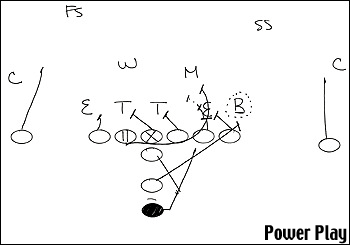
But Brian over at MGoBlog wrote a post today that bugged me a bit, so I’m responding at length. He takes issue with Brady Hoke’s comments about running the “power play” and makes tongue-in-cheek comments about “manball” and “toughness.” I just don’t see the point.
Brian says:
There are consistent reports that Hoke makes condescending comments about the spread at alumni events. Manball? Manball.
He then goes on to suggest that all people who agree with Hoke’s offensive and verbal philosophies are old, mustachioed, and averse to change.
Well . . . okay. So what? Football’s rules have largely been the same since the forward pass was legalized. Eleven guys on the field, four downs to get ten yards, etc. The emergence of the single wing offense in recent years blew people’s minds. How can you have a running back taking snaps and gaining yards?!?!?! Well, it’s because football is football. Blockers need to block, runners need to run, receivers need to catch, tacklers need to tackle. People didn’t figure out how to stop the single wing before it disappeared around the time of Al Capone. It just got boring. So teams started running the wishbone triple option. Then they started running I-formation plays. Then they took out the fullback and created the run-n-shoot. Then they put the quarterback in the shotgun formation and gave him five wide receivers.
What’s the common theme? All of them work. You know, if they’re run well. Paul Johnson is making the triple option work at Georgia Tech, Chip Kelly runs the spread-n-shred at Oregon, and Bret Bielema scored 83 points in one game using good ol’ fashioned power running at Wisconsin.
It seems Brian is infuriated that Hoke would be audacious enough to speak condescendingly about the spread (and zone blocking in particular), but this is what coaches do. Bo Schembechler liked to run the ball and never shied away from his disdain for throwing the ball. But his teams ran the ball well, so it was okay. Mike Leach threw the ball all over the place at Oklahoma and Texas Tech and thinks throwing the ball gives him an advantage over teams that run the ball more. It works. Why does it matter? If Brian were asked, I bet he could completely eviscerate other successful blogs. He could find fault with their advertising, their commenting formats, their content, etc. In fact, he does this type of thing quite often, at least as far as content goes. He thinks his blog is superior to others. If he didn’t, he would change. And that’s fine. But if those blogs are gaining readership and making money, then it’s all just useless babble.
Of course, much of his stance is based on the fact that Denard Robinson, a Dodge Viper in a Jeep Wrangler world, is Michigan’s quarterback. Robinson possesses the talent to be perhaps the most electrifying spread option quarterback in the history of the game (however short the history of the spread option is), but now he’ll be playing under a coach who eschews zone blocking and likes fullbacks. And it’s true that Robinson was a Heisman frontunner at one point in 2010, a record-breaking signal caller who took the country by storm with his speed, elusiveness, smile, dreadlocks, and failure to tie his shoes. That’s not something that should be completely dismissed.
But when it comes down to it, a coach has to meld a player and a system together. He shouldn’t change the system to fit a player, and he shouldn’t abandon a talented player just because the player isn’t an ideal fit.
Hoke said . . .
Once we get the power play down, then we’ll go to the next phase. You know, because we’re gonna run the power play.
. . .which makes Brian unhappy. He talks about how Michigan has athletic linemen and a tiny starting running back (Vincent Smith), which doesn’t exactly make you think “power run.” Power plays are usually left to mammoth offensive linemen, battering-ram fullbacks, and tailbacks with thighs like tree trunks.
Except Michigan’s offensive line was already inching its way toward 300 pounds across the board, Hoke ran plenty of split back sets in 2010 at San Diego State, and running backs coach Fred Jackson has essentially said, “Vincent Smith will probably not be our starter in 2011.”
The power is the base play of Brady Hoke’s philosophy. Just like any intelligent person wouldn’t have expected Rich Rodriguez to run many powers and whams from the I-formation in 2008, Brian shouldn’t expect Hoke to run loads of quarterback iso’s and and zone stretches in 2011. That’s not Hoke’s game, or Borges’s. Rodriguez ran the zone read option with two stiffs at quarterback, Nick Sheridan and Steve Threet. They were game stiffs, but they shouldn’t have been in an offense that required them to run so much. Michigan won three games. Put those guys in a pro-style offense, and I bet they would have won . . . four (the same three plus Toledo). The difference is minuscule. Meanwhile, those running backs, linemen, and receivers gained experience that allowed them to improve in 2009 and then 2010. The growth of David Molk and Martavious Odoms, for example, would have been stunted if they had to play in a pro-style offense that first year. Molk wouldn’t have had practice with the timing and accuracy of those shotgun snaps, and Odoms might have spent the year sitting on the bench. After all, who needs a 5’9″ freshman receiver when you’ve got a two-back, I-formation base set?
And why wouldn’t the power play be the first thing for Michigan’s players to learn? You don’t hire Rich Rodriguez to run the counter trey, you don’t hire Mark McGwire to teach your hitters how to bunt for a single, and you don’t hire Christina Aguilera to teach you the National Anthem.
Here are the 46 offensive snaps from San Diego State’s game against TCU in 2010:
1. Split backs – Power run
2. Split backs – Reverse flea flicker
3. I-formation (on the goal line) – Fullback dive
4. Shotgun spread – Pass
5. I-formation – Iso run
6. Shotgun spread – Pass
7. I-formation – Play action pass
8. Single back, three-wide – Dive
9. Shotgun, split backs – Pass
10. I-formation, three-wide – Power run
11. I-formation – Play action pass
12. Shotgun, three-wide – Pass
13. Split backs – Power run
14. Shotgun, split backs – Screen pass
15. Shotgun, three-wide – Pass
16. Shotgun, three-wide – Zone read option
17. I-formation – Power run
18. Shotgun, three-wide – Pass
19. I-formation – Play action pass
20. Single back, three-wide – Pass
21. Shotgun, three-wide – Pass
22. I-formation – Play action pass
23. I-formation – Power run
24. Shotgun, three-wide – Pass
25. Split backs – Pass
26. I-formation – Naked bootleg pass
27. I-formation – Draw
28. Shotgun, three-wide – Draw
29. Shotgun, four-wide – Pass
30. I-formation – Play action pass
31. I-formation – Iso run
32. Shotgun, split backs – Pass
33. Single back, three-wide – Pass
34. I-formation (on the goal line) – Power run
35. Single back – Dive
36. I-formation – Play action pass
37. I-formation – Zone run
38. I-formation – Play action pass
39. Shotgun, three-wide – Screen pass
40. Split backs – Power run
41. I-formation – Play action pass
42. Split backs – Screen pass
43. I-formation – Pass
44. Split backs – Dive
45. Shotgun, four-wide – Rollout pass
46. Shotgun, four-wide – Pass
I’m using “power run” a little loosely because I don’t want to break down every play – this isn’t a UFR – but the strategy of using a fullback and a pulling lineman is there. Fifteen of those plays (or about 33%) are either based on power running or, in the case of play action, the threat of the power run. These numbers are only based on one game against a very good team, which SDSU trailed for most of the time. But when roughly one-third of a coach’s offense is rooted in a single series of plays, you can’t just scrap the whole thing.
I think the mindset regarding Denard has morphed into “Give him the ball every play and don’t let anyone else mess it up.” Which is fine until your quarterback carries the ball almost 300 times in one season and misses time in ten out of twelve games due to injury. As we saw this past season, the threat of Denard Robinson running the ball was practically just as dangerous as him actually running it. There were all kinds of examples of wide open receivers running free because Denard took a single step toward the line of scrimmage.
There are multiple ways to use his speed, not just as a 300-carry feature back. He can run the naked bootleg (seen in the above playlist), he can sprint out from the shotgun (seen in the above playlist), he can run a quarterback draw (not seen above, but SDSU’s quarterback was s….l….o….w), etc. Run a play action bootleg and see what defensive end or outside linebacker can handle him out on the edge. It won’t look the same as last year, but it can be effective.
Brian also complains about Hoke’s frequent use of some form of the word “toughness.” I agree that it’s a platitude, but welcome to coachspeak. Find me a coach who doesn’t use the word “tough” more often than a Ford commercial, I dare you.
Furthermore, watch Michigan’s team in 2010. Third-and-short on offense? Michigan can’t line up and run the ball. Third-and-short (or third-and-medium, or third-and-long, third-and-a-parsec)? Michigan can’t get a stop. Need a broken tackle? You won’t get it from Shaw or Smith. Need a tackler to stop someone in his tracks? If it’s not Jordan Kovacs, it’s probably not happening. I won’t question any individual player’s toughness, but the team as a whole could use an injection of it. All coaches preach toughness, but if it takes Brady Hoke repeating the word “tough” until his face turns blue to get his team to actually play like it, then I’m fine with it.
Conclusions and predictions:
Rich Rodriguez’s 2010 offense was good. So was Brady Hoke’s. Brady Hoke is not Rich Rodriguez. And despite both being somewhere between chunky and fat, Al Borges is not Calvin Magee.
If Brady Hoke can teach his players how to run the system, it will be successful. If he can’t, it won’t.
The zone read option won’t disappear completely from Michigan’s offense, but it doesn’t really matter. Denard Robinson rarely ran it for Rodriguez, and it wasn’t very effective when he did.
If Ronnie Hillman can run the power frequently and gain 1,500 yards on the ground, then Michigan can find a running back on its roster to run the ball with some consistency. That player will not be Vincent Smith.
Coaches will continue to say “tough,” coaches will continue to say “execute,” but the next time a platitude in March decides the outcome of a game in November will be the first.
My advice to impatient and angry Michigan fans is to wait and see what happens. I wasn’t a huge fan of the Brady Hoke hire when it happened, either, but I am very confident that Michigan will improve defensively. This offense probably won’t be quite as explosive as the 2010 version, but an above average offense combined with an improved defense should improve upon the win total from last season.
*I don’t know what else to call them, but we all know they’re more popular blogs than mine.