Former Michigan Athlete of the Week: Rich Rodriguez

Tag: Rich Rodriguez


18Jan 2011
Uncategorized 3 comments

Former Michigan Athlete of the Week: Rich Rodriguez

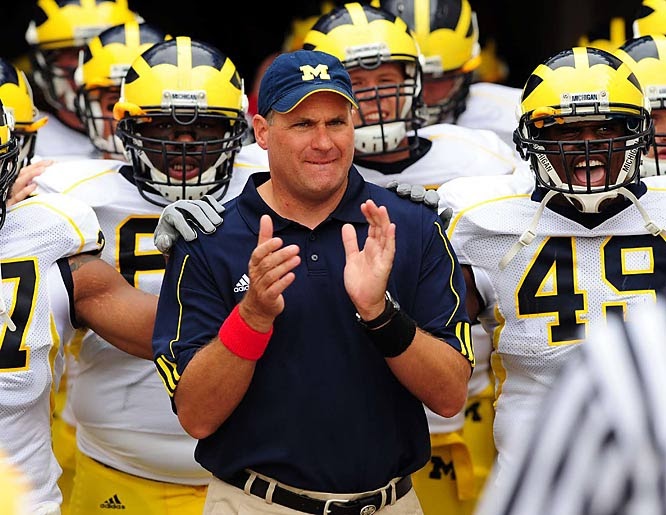
Former Michigan coach Rich Rodriguez led the team onto the field in 2008

Okay, Rich Rodriguez never played football at Michigan.  But he was Michigan’s coach, and he did a very nice thing for charity and the people around Ann Arbor.  Rodriguez donated over 400 items to the Salvation Army to be auctioned, and the proceeds total almost $13,000.  Kudos to Coach Rodriguez.  I was not a fan of his hiring and he frustrated me at times when he was in Ann Arbor, but he seems like a guy who got a raw deal in many ways.  I will be rooting for him to succeed wherever he ends up, whether it’s this year or next.

Honorable mention: New York Jets inside linebacker David Harris had 12 tackles, 1 pass defensed, and 1 interception returned for 58 yards in a 28-21 victory over the New England Patriots.  The win advances the Jets to the AFC Championship game against the Pittsburgh Steelers.  I hate the Jets and despise their coach, but Harris played a good game.

15Jan 2011
Uncategorized 20 comments

Mailbag: Why would Denard change positions?

Denard Robinson: Faster than a horse.

online pharmacy anafranil for sale with best prices today in the USA

Thanks for the blog, which I enjoy. As you are clearly knowledgeable about football, I was surprised by the following comment:

“My initial reaction is to expect that Robinson will transfer, perhaps to Pitt, where former Michigan offensive coordinator Calvin Magee has alighted. He could go to Pittsburgh, sit out 2011, and have two years of eligibility to play quarterback. In my opinion, the best chance Hoke has to retain Robinson is to make a pitch for Robinson to become a running back or wide receiver.”It seems to me that if Robinson stays, he simply must be a quarterback. Otherwise, with Forcier gone, Michigan would be down to one scholarship quarterback, which is clearly unacceptable.

As of now, there are no QB commits in the 2011 class, and at this late date, I suspect the best Hoke could get is a mid-range three-star who will show up in August unprepared for Division I football. If Robinson transfers, we will have to live with that. But if Robinson stays, I cannot imagine that the coaches would choose to hand the job to Gardner, with an anonymous true-freshman three-star kid as his backup.

Let’s assume that Gardner would beat out Robinson in an open competition (not at all obvious to me, but I’ll run with it). You still need two guys ready to play the position. QB is hard enough to learn when you practice it full-time. I can’t imagine that Robinson would have be able to learn a new playbook, get fully prepared to back up Gardner, and have any significant amount of time left to practice other another position that he has never played before.

On top of all that, Robinson seems to want to play QB. I doubt that he would survive a whole season at running back, given his propensity for injury, and he has no history catching the ball. But even if Robinson wanted and were suited to another position, the lack of depth at QB pretty much precludes that idea.

Again: love the blog. I just wonder what on earth you were thinking when you suggested a position switch for Denard. It seems to me the world’s most impractical idea.

Best regards, Marc

Here’s my thought process on the matter…

Denard is an excellent runner. He’s a mediocre thrower and I’m not sure he has the ability to play quarterback in an offense that’s something other than an option offense where he’s a frequent running threat.  His mechanics are iffy, his decision making is iffy, and his 62.5% completion percentage belies his scattershot arm.  There’s a frustrating lack of accuracy on short throws from Robinson that often prevents his receivers from doing much with the ball once it hits their hands – and that’s to say One could point to Roy Roundtree’s frustrating drops – especially in the second half of the season – as a reason that Robinson’s completion percentage should be higher, but I would argue that Robinson’s running ability created a significant amount of wide open, easy catches (see Terrence Robinson’s catch against UConn, Roundtree’s touchdown against Mississippi State, and Roundtree’s long touchdown against Illinois for just a few examples).

I don’t think I said this in the other day’s post, but I expect that Brady Hoke will recruit one or more quarterbacks in the Class of 2011. They probably won’t be top-tier guys, but they’ll be quarterbacks nonetheless. That would leave Devin Gardner, perhaps Tate Forcier (if he’s reinstated), and a freshman or two.

I believe Gardner is a better fit for a pro-style offense than Rodriguez’s zone read option. Gardner isn’t a great runner. I think he’s a pocket guy who can scramble. He would be great out of the shotgun, but he’s not going to break big runs like Denard, Pat White, etc. I won’t say that Rodriguez and Gardner were a mismatch, but I think Gardner would be more effective when deployed like Ohio State’s Jim Tressel uses perennial bonehead Terrelle Pryor.  So here are the steps I was suggesting Michigan should take:

1. Prepare Gardner to be the starter.
2. Bring in a freshman or two and see if they can handle being the backup.
3. Move Denard to RB or WR. Create a package for him to be the “Wildcat QB” or just let him get a few reps at QB in case of an emergency. And if people get hurt ahead of him, he could always move back to QB in a Paul Thompson (ex-Oklahoma QB/WR) or Justin Siller (Purdue QB/RB) type of way.

I don’t think Denard is as injury-prone as you suggested, although I do think he’s injury-prone for a quarterback and was asked to run too much. He got his shoulder dinged up, but the main reason that mattered was because he was playing quarterback. A minor shoulder injury isn’t a big deal for a RB because he doesn’t have to throw. And Denard did bang up his hip and knee, but I would guess a majority of running backs get dinged up throughout the year. They were all pretty minor injuries, and I don’t think they would have been as big of a deal if Denard wasn’t a QB and touching the ball on 100% of the plays.

It’s unclear whether Robinson has the ability to play wide receiver, which requires precise route-running and good hand-eye coordinator.  Quarterbacks usually have pretty good hands, and with Robinson’s speed, I don’t doubt that he could play receiver, at least the college level.  And he’s already essentially a running back at times; we’ve seen his patience in waiting for blocks to develop, his ability to outrun or outmaneuver defenders, and his ability to accelerate through the hole.  Receiver might be a huge question mark, but I have no doubt that Robinson could be an outstanding running back at the college level.  I see no discernible difference between Robinson and Tennessee Titans running back Chris Johnson – one is listed at 6’0″, 193 lbs. and the other is 5’11”, 191 lbs. – who seems to be doing rather well for himself.

Like I said, it’s partially dependent on whom Hoke can recruit to play QB. If he can’t recruit someone for the class of 2011 and Tate Forcier doesn’t return, then Denard surely has to stay at quarterback. But I agree that Denard does want to play quarterback, and there’s something to be said for that. I just also think that Denard’s NFL future depends on his versatility, and playing RB or WR might prepare him more for his future. Guys who convert from QB in college to another position in the NFL generally aren’t anything more than role players in the NFL, although there are a few exceptions (Josh Cribbs, Antwaan Randle-El, etc.). There are guys out there like Julian Edelman, Brad Smith, and Bert Emanuel, but I don’t think many superstar college players want to be the next Bert Emanuel.

None of this is to say that I dislike Denard Robinson or that I want him to transfer.  His leadership, on-field demeanor, effort, and talent are unquestionable.  I hope he remains at Michigan for two more years, Brady Hoke can use him effectively, and Robinson goes on to a long and illustrious football career.  If his goal is to be an outstanding college quarterback, win a lot of games, and re-insert himself into the Heisman race, then it might be in Robinson’s best interest to play at a different school.  But if his goal is to maximize his effectiveness and begin a transition to a position that is more likely to get him to the NFL, it wouldn’t be a bad idea for him to become a running back.

14Jan 2011
Uncategorized 3 comments

Tate Forcier, ex-Wolverine . . . for now

See you later, Tate.  Or not.

During Wednesday’s press conference to introduce new head coach Brady Hoke, athletic director David Brandon was asked about the status of Tate Forcier, Michigan’s starting quarterback in 2009 and backup in 2010.  Brandon responded that Forcier is “no longer with the program.”

Some reports indicate that Forcier is no longer at Michigan due to flunking out during the fall semester.  Mike Forcier, Tate’s father, stated that his son did not flunk out of school. Regardless, he was ineligible for the Gator Bowl against Mississippi State.  Forcier is supposedly enrolled at a community college in the hopes of re-applying to the University of Michigan.  If Forcier were to be reinstated to U of M for the fall semester, he would not lose a year of eligibility, as far as I know; he would be a true junior for the 2011 season.

Forcier is a 4-star recruit from San Diego who enrolled early in January 2009 to take the position vacated by Steve Threet (transferred to Arizona State) and Nick Sheridan (relegated to the bench).  He immediately seized the starting position and  held onto it for his entire season freshman.  The team went 5-7 and Forcier finished 165-for-281 (58.7%) for 2050 yards, 13 touchdowns, and 10 interceptions.

Some reported immaturity and the meteoric rise of classmate Denard Robinson sent Forcier to the sideline for the majority of 2010.  He originally responded poorly to the benching, entertaining thoughts of a transfer when true freshman Devin Gardner overtook the sophomore Forcier for second place on the depth chart during the 2010 opener against Connecticut.  However, Forcier’s third-place spot on the depth chart turned out to be maturity based rather than performance-based, and he eventually overtook Gardner.  Forcier saw spot duty in several games, but really showed out when Robinson was injured against Illinois.  Forcier finished out the second half of the 67-65, triple-overtime victory.  He ended the season 54-for-84 (64.3%) for 597 yards, 4 touchdowns, and 4 interceptions.

I was excited about Forcier when he was recruited back in 2009.  I thought he had a chance to be a version 2.0 Rich Rodriguez quarterback, the type who would throw the ball a lot, run a little bit, and hand off to some as-yet-undiscovered superstar Rich Rodriguez running back.  But . . . uhhh . . . none of that really happened.  Forcier turned out to be a little too headstrong for his own good, throwing passes he had no business throwing, scrambling with the ball loosely held in one arm, taking his starting job a little too lightly, and ultimately losing his spot on the football team.  He still has potential to be a decent quarterback if he matures – both on and off the field.  But I also won’t be surprised if he fades into the background like both of his quarterback brothers (Jason, who was a backup at Michigan and Stanford; and Chris, who played at UCLA and Furman).
Forcier’s departure almost guarantees that new coach Brady Hoke will need to recruit one or more quarterbacks for the Class of 2011.  Even if Forcier finds himself back on Michigan’s campus in the fall, the quarterback position would remain thin with only three scholarship players.  While Hoke has promised to incorporate Denard Robinson’s skills into the offense, I expect that Michigan will try to find a pro-style quarterback before National Signing Day.
online pharmacy motilium for sale no prescription
online pharmacy zithromax for sale no prescription pharmacy
11Jan 2011
Uncategorized 39 comments

Brady Hoke, Wolverine (again)

Tony Siragusa Brady Hoke will be the new Michigan football coach

Athletic director David Brandon released a statement on Tuesday announcing that Brady Hoke, the San Diego State head coach, will replace Rich Rodriguez as the head coach at the University of Michigan.  Hoke was a defensive line coach at Michigan from 1995-2002 and has since spent eight seasons as an FBS head coach at Ball State and SDSU.  He’s married with one daughter.

Hoke’s results at Ball State . . .
2003: 4-8, 3-5
2004: 2-9, 2-6
2005: 4-7, 4-4
2006: 5-7, 5-3
2007: 7-6, 5-2
2008: 12-1, 8-0

Hoke’s results at SDSU . . .
2009: 4-8, 2-6
2010: 9-4, 5-3

Totals . . .
47-50 overall
34-30 in conference
1-1 in bowl games (Hoke did not coach in Ball State’s 2008 bowl game)

The 2010 version of San Diego State finished 16th in total offense, 19th in scoring offense, 43rd in total defense, and 36th in scoring defense.

I am not a fan of this hire.  At all.  The all-time winningest program in college football history just hired a guy with a 47-50 career record, a .484 winning percentage.  The all-time winningest program in college football history just hired a guy who has three winning seasons in his career, or 37.5% of the time.  The all-time winningest program in college football history just hired a guy who was probably Michigan’s third choice – at best – behind Jim Harbaugh and Les Miles.

I said after the 2010 Ohio State game that I thought Michigan’s coaching ranking should be:

1. Jim Harbaugh
2. Rich Rodriguez

If David Brandon was going to wait until after the Orange Bowl to make a firing/hiring, then he should have sewn up Harbaugh immediately or retained Rodriguez (and forced him to fire Greg Robinson).  There shouldn’t have been a third option, like Miles or Hoke.

I don’t care if Brady Hoke is a Michigan Man.  He’s not a proven coach.  He loses more than he wins.  It took him five seasons to get the exact same record (7-6) at a MAC school as Rich Rodriguez earned in his third season at Michigan.

Meanwhile, Hoke runs a pro-style offense whose two quarterbacks in 2010 were 6’4″-6’5″ and between 210 and 215 pounds; Denard Robinson will probably either agree to change positions or transfer to Pitt.  Meanwhile, Hoke had better hope that sophomore/redshirt freshman Devin Gardner can play quarterback fairly well, because . . . well . . . choices are slim.  Well, “choice” is probably too broad of a term there.  I know David Brandon can’t make a decision about a program based on one player or one position, but when you go with a losing coach who also probably plans to totally revamp the offensive and defensive systems, that’s kind of a double blow.

Hoke isn’t all bad.  He had two 1,000 yard receivers in 2010.  He also had the 10th leading rusher in the country.  He went 9-4 and won a bowl game.  By all accounts he’s a nice guy, a solid recruiter, and a fiery leader. 

online pharmacy lisinopril no prescription with best prices today in the USA

By the way, I’m keeping my Rivals account to follow recruiting, but not for the inside information.  Chris Balas, the “insider” over there charged with following the coaching situation, originally implied that Harbaugh would be hired, then he switched his pick to Hoke, then Miles, then Hoke again.  I said after the bowl game that I expected Harbaugh to be the next coach, but after that, I quit guessing.  You get one chance to be right.  If you screw it up, you just throw up your hands and say “I don’t know what the hell is going on.”  Not Balas, though.  I guess you’re bound to be right if, once you’re wrong, you get to change your answer a bunch of times.  I wish the ACT had been like that back when I was in high school.

6Jan 2011
Uncategorized 20 comments

Top 10 Failures of Rich Rodriguez

1.  Losing games.  This is obvious, but it belongs on the list.  Rodriguez finished his three years at Michigan with a 15-22 record.  That winning percentage (.405) is the worst in Michigan history.

2. Losing to rivals.  Rodriguez was 0-6 against Michigan’s two biggest rivals, Ohio State and Michigan State.  If you want to include Penn State, he was 0-9.  He was outscored by a total of 317-140 in those nine games.  It’s unclear how much a couple victories against Ohio State or Michigan State might have affected Rodriguez’s tenure, but wins against Indiana and Purdue don’t carry the same weight.

3. Neutering Scott Shafer.  Shafer has proven to be a solid defensive coordinator at every other stop – Western Michigan, Stanford, and Syracuse.  The former two were prior to Shafer’s hiring at Michigan.  But Rodriguez’s other defensive assistants were proponents of the 3-3-5 and seemed to undermine his authority.  Late in the season, Rodriguez even authorized a mid-season switch of defensive schemes from the 4-3 to a 3-3-5; Michigan subsequently allowed 42 points to Purdue, a team using a converted running back to play QB.  Shafer could have been a good coordinator at Michigan and helped Rodriguez keep his job, but he was fired after the 2008 season because, well, someone’s head needed to roll after a 3-9 season.

4. Hiring Greg Robinson.  Robinson had intermittent success as a coordinator in the NFL and in college.  But just like Shafer, Robinson was a 4-3 or a 3-4 guy.  In my opinion, the defense showed some promise in 2009, when Robinson used safety Steve Brown as an outside linebacker and freshman Craig Roh as a rush linebacker.  However, Rodriguez used the 2009-10 offseason to convert to the 3-3-5, and Robinson was obviously uncomfortable and inexperienced with running that defensive set.  That resulted in 458 points allowed in 2010, an average of 35.2 points per game.

5. Not retaining holdover players from the Carr era.  Michigan was extremely short-handed in 2009, fielding a team of 69 or 70 players who were given scholarships right out of high school.  Some of those players were bound for a career of anonymity, I’m sure, but others were not.  Quarterback Ryan Mallett was vaguely in Heisman contention this season.  Justin Boren became an All-Big Ten guard at Ohio State.  Adrian Arrington chose to enter the NFL Draft (and became only a 7th round choice) a year early.  Rodriguez can’t shoulder the blame entirely for these departures, but there’s no question that a guy like Boren would have been helpful in 2008 and 2009, the former season featuring a starting guard (John Ferrara) that was a mid-season position switcher from defensive tackle.

6. Stretching too much.  The Detroit Free Press reported some trumped-up charges regarding Michigan’s practice schedule, and that sparked an NCAA investigation.  While the charges were blown out of proprtion, they were a black mark on the Michigan program and resulted in probation and some lost practice hours.  Rodriguez wasn’t responsible for everything that went wrong in the compliance department, but his staff did fail to keep track of its countable practice hours accurately and a graduate assistant watched some voluntary 7-on-7s, which is a no-no.

7. Not finding his Steve Slaton.  Pat White got a lot of hype at West Virginia, but running back Steve Slaton was almost as important as White.  And prior to White’s arrival on campus, Rodriguez used running backs like Quincy Wilson and Kay-Jay Harris to great effect.  Rodriguez never found “that guy” at Michigan, partially due to injuries and partially due to recruiting.  Therefore, the offense wasn’t as spectacular as it might have been.  The lack of a running game cost Michigan a couple games throughout his tenure.

8. Not developing top prospects.  Rodriguez seemed to have an abnormal number of high-end recruits bomb out of the program.  And it’s probably a coincidence, but most of them seemed to come from the defensive secondary.  Four 4-star players recruited by Rodriguez never made a significant positive impact at Michigan (Demar Dorsey, Boubacar Cissoko, Justin Turner, Vladimir Emilien), which resulted in five true freshman defensive backs seeing significant time in 2010.  Furthermore, arguably Michigan’s best prospect in the last few classes (William Campbell) has yet to make an impact at Michigan and just switched from nose tackle to offensive guard in the middle of the season.

9. Handing out the #1 jersey to J.T. Floyd.  Before Rodriguez ever coached a snap at Michigan, he tried to give the #1 jersey to true freshman cornerback J.T. Floyd.  He was either unaware of the jersey’s significance or chose to ignore that aspect, but it was nonetheless a mistake.  Nothing seemed to highlight the fact that Rodriguez wasn’t a “Michigan Man” more than the #1 jersey snafu, which pitted some alumni and fans against him from the start.

10.  Poor player personnel decisions.  Part of the heat falls on the assistant coaches, but Rodriguez shoulders most of this blame because he has the final say: Rodriguez didn’t put his players in their best positions to succeed.  Running backs Sam McGuffie and Vincent Smith played far too much when there were more productive and explosive backs on the roster (Brandon Minor and Michael Shaw for starters).  Obi Ezeh should have been an outside linebacker starting back in 2008; and at least according to their play on the field, Ezeh should have been replaced by Kenny Demens much earlier.  Cameron Gordon – who has linebacker speed – spent half the 2010 season playing free safety.  William Campbell spent two years toiling on the defensive line before making a permanent move to the offensive line, and he didn’t even redshirt to allow for a fifth year of eligibility.